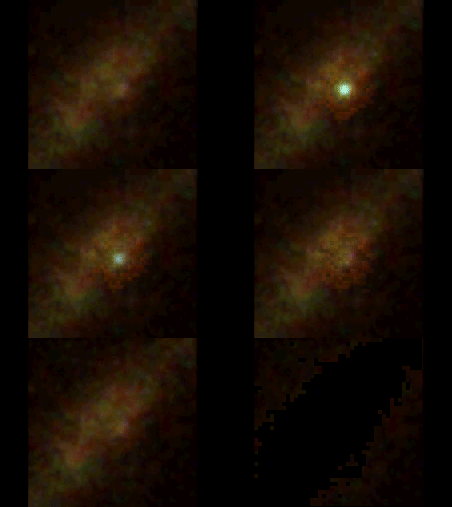
Cycle of pulsed gamma rays from the Vela pulsar
Autor/Urheber:
Roger Romani (Stanford University) (Lead), Lucas Guillemot (CENBG), Francis Reddy (SPSYS)
Shortlink:
Quelle:

Größe:
226 x 169 Pixel (56021 Bytes)
Beschreibung:
This image shows pulsed gamma rays from the Vela pulsar as constructed from photons detected by Fermi's Large Area Telescope. The Vela pulsar, which spins 11 times a second, is the brightest persistent source of gamma rays in the sky. The bluer colour in the latter part of the pulse indicates the presence of gamma rays with energies exceeding a billion electron volts (1 GeV). For comparison, visible light has energies between two and three electron volts. Red indicates gamma rays with energies less than 300 million electron volts (MeV); green, gamma rays between 300 MeV and 1 GeV; and blue shows gamma rays greater than 1 GeV. The image frame is 30 degrees across. The background, which shows diffuse gamma-ray emission from the Milky Way, is about 15 times brighter here than it actually is.
Lizenz:
Public domain
Credit:
Goddard Space Flight Center
Credit: NASA/DOE/Fermi LAT Collaboration
Credit: NASA/DOE/Fermi LAT Collaboration
Bild teilen:


Relevante Bilder


Relevante Artikel
NeutronensternEin Neutronenstern ist ein astronomisches Objekt, dessen wesentlicher und namensgebender Bestandteil Neutronen sind. Ein Neutronenstern stellt ein Endstadium in der Sternentwicklung eines massereichen Sterns dar. .. weiterlesen
PulsarEin Pulsar ist ein schnell rotierender, stark magnetisierter Neutronenstern. Pulsare bestehen zu annähernd 90 % aus Neutronen und besitzen eine etwa dem Eineinhalbfachen der Sonnenmasse entsprechende, aber auf einen Radius von nur ca. 10 km komprimierte Masse. .. weiterlesen